


With proper legal guidance, bringing siblings to live in the United States as permanent residents is a process that unfolds in four stages: filing Form I-130, USCIS approval, NVC review, and final Green Card issuance.
Here we explain the requirements, documents, and wait times to achieve family reunification without errors or delays.
At Lluis Law our immigration lawyers in Los Angeles guide you through every stage to ensure your petition moves properly and meets all requirements.
LATINOS WITH OVER 60 YEARS EXPERIENCE
Tell Us Your Case
How does bringing siblings to live in the United States as permanent residents work?
For a U.S. citizen to request a sibling’s Green Card, they must file for family-based immigration with USCIS.
- Specifically, this process is initiated with Form I-130 (Petition for Alien Relative), which starts the official immigration process.
- Once the petition is filed and accepted by USCIS, siblings are placed on a waiting list.
- When their turn arrives, the government may issue an available visa so they can immigrate to the United States and later obtain a Green Card.
Note: Place in line is determined by the petition’s filing date (priority date). Filing as early as possible is recommended.
Requirements and documents to petition a sibling in the United States
Before filing, both the citizen petitioner and the sibling beneficiary must meet certain legal requirements to avoid delays and ensure the case moves properly with USCIS.
Petitioner requirements:
- Be a U.S. citizen and at least 21 years old at the time of filing.
- Accurately complete Form I-130.
- Have no disqualifying convictions under the Adam Walsh Act.
- Sign the Affidavit of Support (Form I-864) when the residency application is filed.
Beneficiary requirements:
- Prove a valid family relationship with the U.S. citizen petitioner. Step-siblings qualify if the marriage creating the relationship occurred before both turned 18.
- Be admissible to the United States (no bars to residency due to serious crimes, immigration fraud, or relevant medical issues).
- Understand the application of the Child Status Protection Act (CSPA), applicable to derivative children who meet the age requirements.
- Maintain lawful status if already in the U.S. and seeking adjustment; otherwise, the process is completed from the home country.

For other family reunification scenarios, see “Can I bring my parents to the USA permanently?” and “Can a U.S. citizen sponsor a child over 21.”
Required documents to petition a sibling in the United States
After the petition is approved by USCIS, the next step is to gather the documents proving the relationship and the beneficiary’s eligibility.
This stage is crucial: any error or missing proof can delay the consular interview.
1) USCIS stage:
- Completed and signed Form I-130.
- Relationship evidence (birth certificates, adoption records, or parents’ marriage certificates for step-siblings).
- Proof of petitioner’s U.S. citizenship (U.S. passport, birth certificate, or naturalization certificate).
- Certified English translations of any foreign-language documents.
- Payment of the I-130 filing fee.
- Keep the I-797 notice issued by USCIS.
2) NVC stage:
- Form DS-260 (immigrant visa application).
- Form I-864 with the petitioner’s or joint sponsor’s financial evidence.
- Beneficiary’s civil documents (birth certificate, marriage or divorce certificates, police records, passport).
- Payment of NVC fees (visa and I-864).
- Photographs and medical exam with a panel physician.
3) Interview and post-approval:
- Appear with all originals and copies.
- If the officer requests additional evidence, the case may be delayed.
Once the visa is approved, the beneficiary enters the U.S. as a lawful permanent resident and receives the Green Card by mail.

If the sibling beneficiary has inadmissibility issues, they may seek a waiver of inadmissibility.
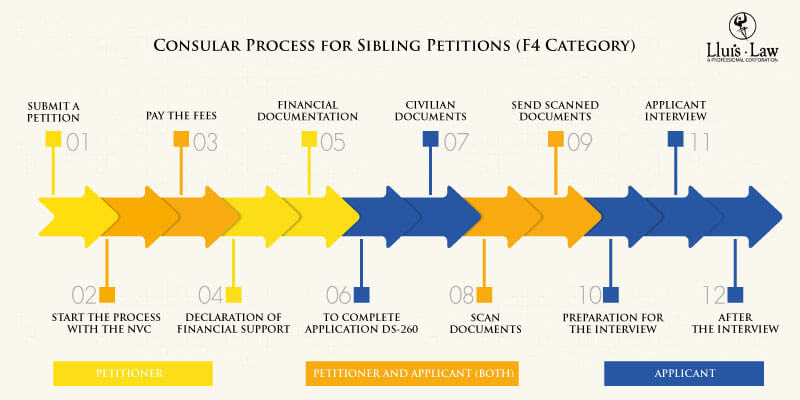
Step-by-step process to petition a sibling
The sibling petition process involves several steps that can take years.
Understanding each phase helps avoid common mistakes and anticipate wait times with USCIS and the National Visa Center (NVC).
Step 1: File Form I-130 with USCIS
- The U.S. citizen starts the process by filing Form I-130 and selecting “Brother/Sister” in the appropriate category.
- They must attach proof of the relationship (birth/adoption records or legal certificates).
- It is crucial to ensure that all information matches the official documents.
See the detailed guide: How to fill out Form I-130.
Step 2: Wait for approval and transfer to the NVC
- After approval, USCIS sends the case to the National Visa Center (NVC), where it remains until there is an available visa in the F4 category.
- The NVC will notify when to proceed with additional forms and the consular interview.
- Meanwhile, the petitioner should keep their information updated and retain copies of all submitted documents.
You can track monthly family-based visa movement in the U.S. Department of State Visa Bulletin, which publishes current priority dates by country and category.
Step 3: Complete the Affidavit of Support and other documents
- The U.S. citizen signs Form I-864 to demonstrate stable and sufficient income.
- The beneficiary completes Form DS-260 and uploads scanned copies of their civil documents (birth records, passport, marriage or divorce certificates).
- If the sponsor does not meet the income requirements, a joint sponsor can be added.
Step 4: Obtain the visa and enter the United States
- The beneficiary undergoes a medical exam with an authorized physician.
- They attend the consular interview with all required documents.
- If approved, they receive an immigrant visa to travel to the U.S.
- Upon entry, they automatically become a lawful permanent resident.
- The Green Card arrives by mail at the registered address.
- If the beneficiary already lives lawfully in the U.S., they may adjust status instead of using consular processing.
For next steps after USCIS approval, see Form I-130 Approved, What’s Next?

Available family reunification paths
When a U.S. citizen petitions for a sibling (category F4), there are two routes depending on where the beneficiary lives:
- Consular processing: For applicants living outside the U.S. Once the I-130 is approved and a visa is available, the case moves to the NVC, which coordinates document review and the consular interview.
- Adjustment of status (I-485): For those already in the U.S. with valid lawful status and a current priority date. This allows obtaining permanent residence without leaving the country. Generally requires lawful entry (visa, parole, etc.).
If your case is based on marriage, see How long does it take to bring spouse to USA.
Cost of petitioning a U.S. citizen’s sibling
The cost of petitioning a sibling in the United States varies depending on the required forms, the beneficiary’s location, and whether the process occurs inside or outside the country.
Immigration fees are updated periodically, so always verify current USCIS amounts before filing.
Key USCIS fees
- Form I-130: $675 if filed on paper / $625 if filed online.
- Form I-485 (Adjustment of Status): $1,440 for adults and $950 for children under 14 filed with a parent.
- Affidavit of Support (Form I-864): no filing fee; the sponsor must show financial capability (tax returns, employment, other income).
- Medical exam (Form I-693): not a USCIS fee. Typically ranges from $250 to $450 depending on location and provider.
- Consular fees (visa processing): vary by consulate and visa type (≈ $325–$445 per applicant), plus translations, photos, and mailing.
Additional expenses and official sources
Beyond the basic fees, there are other costs to anticipate to avoid setbacks during the process:
- Certified translations of civil and court documents (birth, marriage, divorce, adoption, etc.).
- Document shipping to USCIS or the NVC, with variable costs depending on country and courier.
- Legal fees or professional form-preparation fees, depending on case complexity.
- Required vaccinations and medical exams by authorized physicians (consulate or USCIS).
The final amount also depends on whether the beneficiary seeks residence through consular processing or adjustment of status. Each path has its own requirements and costs.
To avoid mistakes and incorrect payments, always verify fees and requirements directly on USCIS official sources before filing.
How long does it take to petition a U.S. citizen’s sibling?
Timeframes depend on visa availability in the F4 category (siblings of U.S. citizens) and the beneficiary’s country of origin.
- Because this category has annual caps, wait times may exceed a decade and, in some cases, reach 17 to 23 years.
- Case progress is determined by the priority date (the date USCIS receives Form I-130). Cases move chronologically as visas become available.
- When the priority date becomes current, the NVC contacts the beneficiary to continue to the next stage.
Factors that affect wait times
- Beneficiary’s country: longer queues for Mexico, the Philippines, India, and China due to high demand and per-country limits.
- F4 visa availability: the annual limit causes backlogs and delays.
- Initial USCIS processing: approval of I-130 can take several months before transfer to the NVC.
- Incomplete documentation: errors or missing certified translations add months.
- Requests for Evidence (RFEs): if USCIS asks for more information, review time partially restarts.
Practical tips and legal alternatives
Some of the most useful practical tips include:
- File as early as possible. The priority date is set the day USCIS receives Form I-130.
- Check your case status regularly in the USCIS portal. Use your receipt number.
- Keep your address updated and avoid form mistakes. Late changes or incomplete forms cause delays or RFEs.
- Keep copies of every notice and document (USCIS and NVC).
- Respond promptly to any request for evidence to avoid resets or backlogs.
Legal alternatives to speed up family reunification
While waiting for an F4 family visa to become available, there are other legal options that may allow faster reunification:
- Cuban Adjustment Act: Cuban nationals (and qualifying spouses and children) may adjust status after admission or parole in the U.S.
- Cuban Family Reunification Parole (CFRP): grants temporary parole to certain family members with an approved I-130. See: Cuban family reunification parole program.
- Other possible avenues: depending on the case, alternatives include:
- Spousal or immediate child petitions;
- VAWA visas;
- U visas and T visas for victims of violence or certain crimes.

Frequently asked questions about bringing siblings to live in the United States as Lawful permanent residents
Below we answer the most common questions about bringing siblings to live in the United States as permanent residents, the required criteria, and process steps according to USCIS.
Can a U.S. citizen petition a married sibling?
Yes. Marital status does not prevent the process. A U.S. citizen sibling can petition a married sibling under the F4 category.
The spouse and unmarried children under 21 can be derivative beneficiaries.
Can a U.S. citizen petition an older sibling?
Yes. The beneficiary’s age is not a limitation, as long as the petitioner is at least 21 years old and a U.S. citizen.
How much does a sibling petition cost?
The primary cost is the Form I-130 fee ($625 online / $675 paper) plus complementary forms such as I-485 for adjustment of status.
Additional expenses include translations, medical exams, and legal fees. Verify current amounts on USCIS.
How long does a sibling-to-sibling petition take?
Average wait time is around 10 to 15 years, though it varies by country of origin and F4 visa availability.
How long does a U.S. citizen’s sibling petition last?
The entire process, from filing Form I-130 to issuance of lawful permanent residence, can exceed a decade.
USCIS processes cases based on the priority date and movement of the Visa Bulletin.
Can a U.S. citizen petition a sibling?
Yes. Any U.S. citizen over 21 can request permanent residence for a brother or sister under the F4 category.
Other common questions about sibling petitions
Below are some of the common questions our immigration attorneys at Lluis Law receive about petitions for siblings of U.S. citizens.
What if USCIS denies the petition?
In case of denial, USCIS will send a letter explaining the reasons.
The petitioner may file an appeal using Form I-290B or a motion to reopen if new evidence exists.
Working with an immigration lawyer increases the likelihood of success.
Which relatives can immigrate with the sibling?
The sibling’s spouse and unmarried children under 21 may immigrate as derivatives, provided they remain eligible until the visa is issued.
Can lawful permanent residents petition their siblings?
No. Lawful permanent residents must first naturalize before petitioning siblings.
Only U.S. citizens can file Form I-130 in this category.
Can my sibling visit me while waiting for residence?
Yes, as long as they obtain a nonimmigrant visa and demonstrate strong ties to their home country (family, employment, or property).
They must show they do not plan to overstay the authorized visit.
Contact immigration lawyers in Los Angeles
You now understand how bringing siblings to live in the United States as permanent residents works and the steps to achieve family reunification.
While the process can be lengthy, proper planning and accurate form preparation make the difference between a successful case and one that stalls.
At Lluis Law we understand the importance of keeping your family together. Our team examines every detail—from the family relationship to financial documentation—to ensure your petition meets all requirements set by USCIS and the NVC.
If you want to start your case or have an existing petition reviewed, contact us today.
LATINOS WITH OVER 60 YEARS EXPERIENCE
Tell Us Your Case


